
I'm sitting on an air mattress in my new unfurnished Brooklyn apartment listening to the sounds of the city out of the window after a long day of client meetings. At one point I was thinking "Man I wish I bought that ugly sofa from Ikea so I'd have something to sit on" and next thing I knew I was considering the Tao of Outreach Link Building.
I know, I know. Outreach link building is hard. It takes time. You send 1000 emails and end up with seven links but I believe that's largely because most search marketers approach link building the wrong way. In fact I'm going to declare right now that link building should be the easiest and most fun part of SEO.
Yep, I said it but wait, let me finish before you head to the comments to tell me why I'm wrong.
First, let me say that I love where we are moving with link building as a community especially with the stuff the
King of Link Building, Justin Briggs,
has been giving us lately. In fact what I have to offer for your consideration is very much an expansion on
Dan Deceuster's new perspective on link building.
There is often a lot of talk about who to target and how to find them but there isn't much about how you get their attention, sustain it, close the deal and maintain the relationship. With the exception of what Justin spoke about in his
Link building webinar, most recommendations revolve around building form letters and tailoring them a little more depending on the target.
In my experience, this is the least effective method to engage in outreach link building. The following are five principles that I have identified and streamlined to improve my link building success rate from about 20% to around 80%.
 Talk to People Like People (Throw Out Your Form Letters)
Search Marketers tend to think of link building as obtaining a link from a website. Truly link building is speaking to a person and convincing them to take a real world action that is beneficial to you. Link building is cast as a very impersonal process where we use the various methods to identify link targets, write a form letter and fire away expecting that the return on these outreach emails will be so low that it doesn't make sense to spend time on them.
Honestly, even just reading that back makes me think of how counterintuitive the process is.
Everyone reading this post has been subject to some sort of Email, Twitter, Myspace, Facebook spam. Hell, even Barack Obama and his friends have been spamming me for five years now (ok I opted-in but wasn't my vote enough – stop spamming me!). Think for a second, how do you react to spam? You erase it or ignore it of course. Even as an owner of various sites people often contact me asking me for links or offering me SEO services and such – with form letters that never get opened. Here's one I received since I started writing this post:
Certainly not a link building request but I imagine it's not far off from how many Search Marketers are writing their link request form letters.
If this is up for debate I challenge you to go on a dating site like Match.com and copy and paste the same form letter to 50 women. I guarantee a low rate of response and the girls that do respond aren't going to be the ones you wish responded.
People can usually sense a form letter immediately. Dare I say it? No, I'll let my homey Link from Legend of Zelda tell you.
I myself had failed many times using the same approach to link building (not with women, of course). Then one day I realized that the link building strategies I was taught are counterintuitive to everything I've learned as someone who has had to network across various fields whether it be my Search career, in music as a performer and booking agent or as a generally (somewhat) social person. Be warned, my approach requires a genuine interest in people. Here goes:
- Opening– Linkbuilders are typically very heavy handed and send an email that basically says "hey I have this site will you link to me because of x,y,z?" The only thing that I attempt to accomplish with my first email is an engaged response. I never bring up the idea of wanting something from this person until later in the email or tweet thread; the same way I wouldn't walk up to a girl and say "you're hot, let's have sex because I'm cute, I drive a luxury car and I have an apartment in a cool part of Brooklyn!" I keep my opening correspondence short, engaging and contextual to something that person has tweeted about or written on their site/blog.
Quite simply people love to know their work has been enjoyed, viewed, absorbed so actually take the time to read it and strike up a conversation about something you truly find interesting. As marketers we are taught to optimize one message that appeals to many people; there is simply no place for that in effective outreach link building.
In the following example I'm building links for the official Transformers 3 movie site (not that this would ever happen because those sites are always powered by Paid Media).
The Old Way of Link Building:
Subject: Transformersmovie.com Link Request
Hello,
I am contacting you to request a link to Transformersmovie.com from your site. We have trailers, downloads, exclusive video and a gallery. Visitors can also find information on movie times and buy tickets online.
I see that your blog talks about Transformers and I think visitors of your site will find this content very useful.
Please link to http://www.transformersmovie.com using the anchor text "Transformers" or use the following code:
Transformers.
Please contact me if you have any questions.
Thank you for your time and careful consideration.
Transformers Web Team
www.transformersmovie.com
While I don't doubt that some Link Builders have some very spiffy form letters much better than this, most of the time they still come across just as sterile as the above.
The New Way of Relationship Building:
Subject: Power Rangers, Are You Serious?!
Hey Zelda,
I just read your awesome post where you compared Voltron and Power Rangers to Optimus Prime and crew. Not sure if I agree that the Power Rangers could have taken out Megatron in the first film. I mean honestly, they had trouble with giant bears on their own show!
Truthfully, I think Voltron would make short work of all of them. Speaking of Voltron have you ever seen this hilarious live action spoof? http://www.youtube.com/watch?v=YtwX0nuqPO0
Anyway I'm curious to know what you think of the new Transformers film. Give me a shout when you get a chance!
-Link
Link of Hyrule
Transformers Web Outreach Team
mike@transformersmovie.com
www.transformersmovie.com&
Option two is clearly stronger and was even more fun to write. Creating context allows me to hit more touch points to elicit a response. Also the engagement is all about opinion and sharing thus framing the conversation as just that – a conversation rather than a link request.
- Sustaining – Sustaining is all about keeping the conversation going, building a rapport with this person and offering something of value. Most people will be tempted to jump the gun at this stage and just ask for the link right when the person responds. This is not the way to go because then your original correspondence appears to be a thinly-veiled link request, which it of course is but that is the mindset we are trying to eliminate.
In this stage it is good to have some content to share that this person may be interested in. It could be related to the site you're trying to get a link for or it could not, the important point is that you demonstrate that you are worthwhile resource of some sort whether it be for entertainment or educational purposes. Not only does this build trust but establishes context. This phase can continue as long as it takes for you to actually develop a relationship. In fact let's just rename link building "relationship building."
Continuing with our robot cartoon blogger example:
Hey Link,
LOL Link, that video was hilarious and thanks for reading my post but there is noooo way that Voltron could take out the combined power of the MegaZord!! I'm not even sure Voltron could take out the GoBots!
I haven't actually seen the film yet. Do you actually work on the Transformers site?
Best,
Princess Zelda
Princess Zelda,
The GoBots? Zelda, you're killing me! The GoBots were a cheap rip off of the Transformers they should not be typed in the same email as Voltron! I bet you preferred Silverhawks over Thundercats too, didn't you? HA!
Anyway, yep I sure do work with the Transformers web team. Do you have any interest in seeing the film?
-Link
Link of Hyrule
Transformers Web Outreach Team
mike@transformersmovie.com
www.transformersmovie.com
Hey Link,
LOL, you just keep making me laugh. Silverhawks?! I didn't think anyone remembered that cartoon. It was pure redux of Thundercats just as bird people!
I definitely do want to see the new Transformers film! Can you hook a princess up?
Best,
Princess Zelda
Notice how the suggestion of value causes the link target to become further engaged and it sets up the link request as a natural progression in this case in exchange for tickets.
- Closing – The key thing in this phase is to only pull the trigger on asking for a link after context and value are established. The link request then becomes an aside to the correspondence rather than the entire correspondence.
At the end of our sustain phase Zelda, our Robot Cartoon Blogger, has taken the bait realizing that the link builder potentially has something of value to her and then puts the link builder in a position to close the link deal. The nature of the conversation puts Zelda in a position where she is comfortable enough to make the request so when the link builder requests the link it is natural for him to ask for something in return.
Princess Zelda,
Hmmm...well I don't make it a habit to do this, but since you have such good taste in cartoons....
Sure, I can get you two tickets to see the film in your local theater, but in return can you write a review or write another one of your great articles and link back to our site?
If that works just shoot me your closest theater and I will send you a Fandango confirmation code for your tickets.
Also are you on Twitter? I'd love to keep up with the stuff you are posting on your blog!
-Link
Link of Hyrule
Transformers Web Outreach Team
mike@transformersmovie.com
www.transformersmovie.com
Just like that, we've just built a link just from talking about your favorite cartoons. The challenge and the fun is in finding something that interests both of you and using that information to build a relationship. The less you have to offer in the form of incentives the more sustaining and rapport building you will need to do in order to build the link. Do not think that this method only works with incentives. Value can be established in many ways when building a relationship.
A caveat that I should offer here is that it is painfully obvious when this approach does not work because people will not reciprocate the engagement. It might result in a simple "thanks for reading" response in which case you can decide whether you want to do more research to identify a different touch point and try again or to just move on to someone else. As you begin to adopt this process I'd say plow through but soon you will be able to spot a lost cause.
 Standout in the Inbox
How do you feel about spam? Probably the same way you feel about telemarketers. When people can tell by their caller ID that a telemarketer is calling they don't pick up the phone. By that same token if they can tell an email is spam, they avoid it.
Never send an email with "Link Request" or something to that effect in the subject; they are doomed to never get opened. You want to take an indirect approach because you don't want the link target to decide before ever seeing what you had to say; this is the Trojan Horse of link building. Trojan Horse in the classic sense not a virus.
Let's go back to the email I mentioned earlier in this post. Here's my inbox on that day:
Notice that this email was the only one out of all the other spam that was opened. It was clear exactly what every other email was however there is some mystery as to what the "let's work together" email was about. It appeared natural and it stood out to me because it looked like someone requesting some sort of collaboration. It has a real name and the subject was in lower case. It resembles the emails I receive from people that want to send me beats or hire me to guest appear on their albums.
Obama tricks me into clicking his emails pretty often too. I don't always look at who the emails are from when I get them but most of my friends use short email subjects (like the following) that cause me to click through:
Even when I do look at the Sender name it might be a quick glimpse to make sure it's a person and not a company or something.com. It was my assumption that other people reacted this way when I started to apply these principles and therefore the improvement in response rate is the only thing in the way of science I have to show for this.
However what I can show you is an example of a subject fail straight from the inbox of my fellow Philly to Brooklyn SEO transplant
John Doherty:
1-800 Contacts clearly runs some sort of CRM software for these types of emails and either someone was asleep at the wheel or they input the fields the wrong way. This could easily happen to you in a program like Link Assistant. Don't be that person. However judging by the format of the sender and subject fields it is highly unlikely that these emails will have an open rate worth talking about.
I'm sure there are more comprehensive studies on email optimization but to summarize:
Tips for Standing Out in the Inbox:
- Keep Subjects Short
- Keep Subjects Natural
- Do Not Use "Link Request"
- Send Emails as a Person (Not as a company or a "web team")
- Include a Natural Salutation (The first line will appear next to the subject)
 Do Your Research
I don't want to encourage you to stalk your targets so...study your targets. Bloggers and webmasters are certainly not the most private people in the world and therefore have shared their thoughts, favorite music, films, travel plans and other endless minutia about themselves online for years – use it to develop your context for the initial email.
User data drives models of people for targeting our broad messaging, it only makes sense to use user data to create context for our specific messaging.
Don't get caught up in the whole romantic comedy "OMG I manipulated you but it turns out I really love you and I wish I could take it all back" aspect of this. Think of it as a way to increase your odds of relating to someone the same way that a girl in WuTang shirt would make me ask if she was at the Raekwon concert in Prospect Park last weekend (Shout out to John Doherty, Tom Critchlow, Rob Oursey and his wife!). Again, Context is King.
Choose something that relates back to the content that the person had written about on their own site. The subject should be something that you can relate to, offer insight on and speak at length. So if I'm doing link building as illustrated in the example I might check Zelda's Facebook, Twitter, and Last.Fm and I might weave a conversation about how Voltron was actually created after Power Rangers contrary to popular belief and the stance of her blog post. Then I might end the email with something to the effect of "wouldn't Radiohead be a great choice for the Voltron soundtrack?" Now we have a conversation that is still in context if only tangentially to the topic at hand.
Researching your targets turns link building into a video game – with a strategy guide.
 Offer Value
We tend to think of link building in terms of "what can this site offer me?" rather than "what is it about my site that will be interesting or useful to this webmaster or blogger?" or "what of value can I introduce this person to?"
Depending on where you are contacting them from part of offering value can be just in the fact that you have reached out to this person. It's important that if you are working for a client with some sort of reputation in the space that you are building links for that you obtain an email alias on their domain. For example if you are doing link building for SEOmoz then you should have an SEOmoz email address. So if you are following up with a blogger who has written a review about SEOmoz's software offering then they feel as though their voice has been heard by the company. Make sure your signature is reflective of their company's location so they recognize they are speaking with a real person and not something automated.
In a lot of cases you may not be link building for someone reputable so it's important that you share something of value with this person. Perhaps you have a link to some content important to the niche that hasn't been seen by too many people – share it with your link target. Maybe an awesome video has just floated around your office and you are actively going back and forth over email -- toss it in there. Maybe you just have an interesting story that you can share with this person or anything. Failing all that it's very important to have any client provided incentives.
The bottom line is approaching link building the same way as when you meet one of your friend's friends and your efforts will be more effective.
 Maintain the Rapport
No one likes to be used. Therefore it is important to maintain an active rapport with your new friends otherwise if you only contact them when you need a new link they will be less inclined to help you out. Twitter is the perfect place to maintain this rapport. Follow your newfound friends and encourage them to follow you and be sure to retweet their links and engage with them from time to time so you are in constant contact. What the both of you tweet continues to generate context so even if you faked your way this far (which you won't if you have a genuine interest in people) you can easily start the process again based on their latest tweets.
Conclusion
Is this scalable? Well, it depends how much information you need to sift through to find a hook for the person you're reaching out to. Once you go through this process enough times it takes little more than the time it takes to uncover a buried email address. However outreach link building isn't the place you need to be looking for scalability to begin with.
The benefits of this approach are two-fold. 1. Your link building becomes more effective and while you may not reach out to as many people, you will convert a lot more of the people that you do. 2. You are building a rapport with many people that you can then activate in Social Media as it becomes more of a ranking factor.
Link building is viewed as an arduous task that no one really wants to engage in and it really shouldn't be. Link building is really an opportunity to make friends throughout the web and Social Media. Perform your link building as a marksman rather than a drive by shooter and you will see better results.
Context is King. Link Building is dead. Long live Relationship Building.
Also you'll be happy to know that I now have a bed, a desk, a chair and a dresser. Definitely give me a shout if you're ever in Brooklyn!
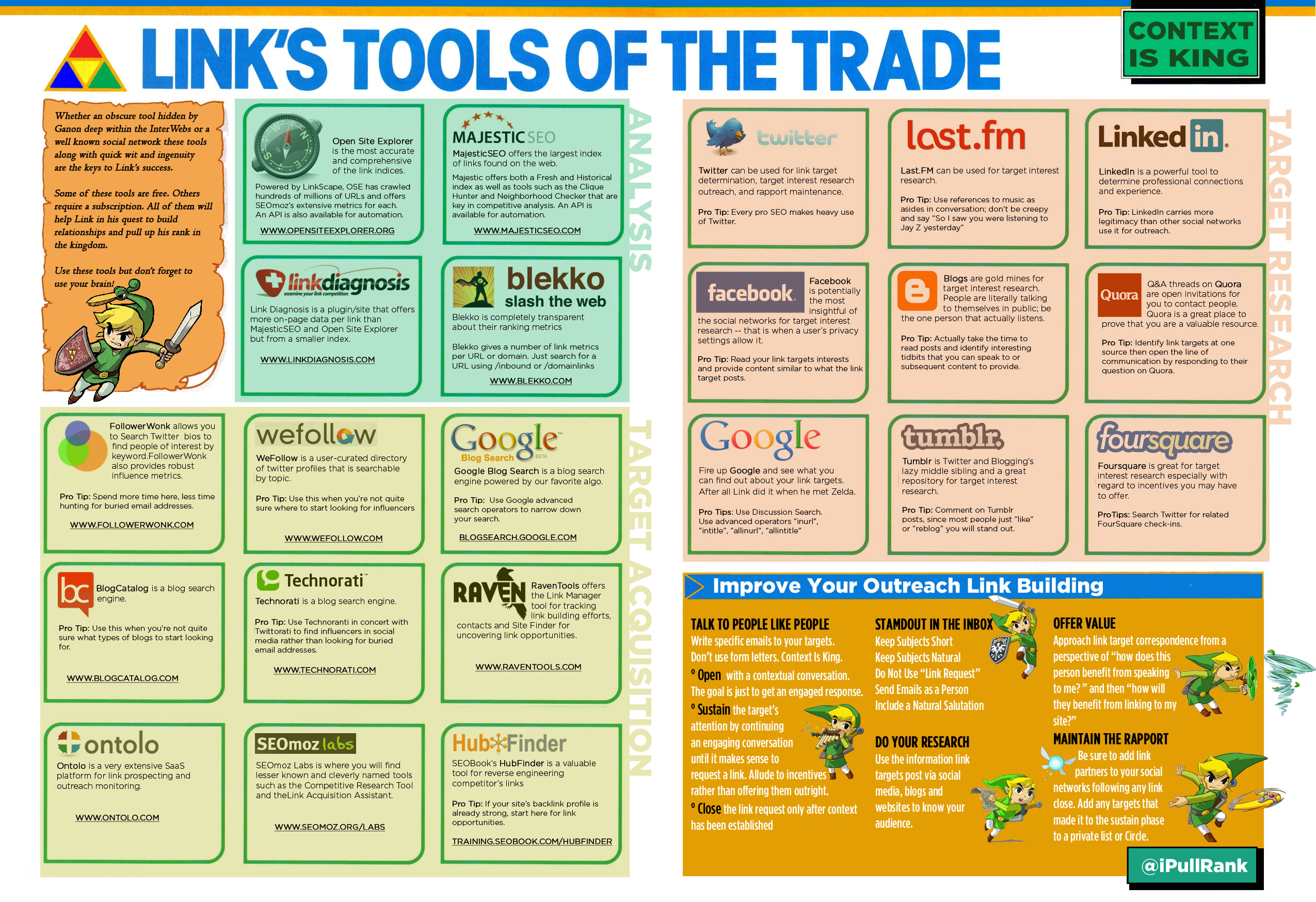
Oh yes...almost forgot the infographic. Go easy on me, it's my first one!


 Google vs. Facebook in 2012: How Is the SEO World Changed?


